At Interstate Waste Services, we are proud of our commitment to making the world a more sustainable place by implementing forward-thinking recycling solutions and waste diversion strategies. Through our investments in cutting-edge technology, an extensive network of material recovery facilities, and a highly skilled team, we achieved impressive recycling results in 2025, demonstrating our successful approach to sustainable waste management.
Our 2025 Diversion Results
In 2025, we diverted 294,519 tons of fiber, metal, and plastic across our seven recycling facilities. These 589 million pounds of material represent a 19% increase from 2024.
Here is a breakdown of our 2025 Recycling Volumes:
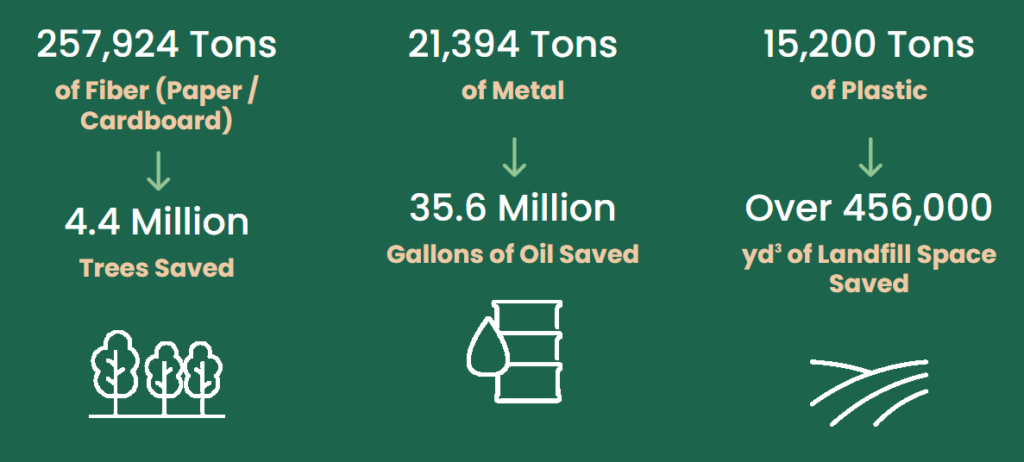
- 257,924 Tons of Fiber (Paper & Cardboard)
- 21,394 Tons of Metal
- 15,200 Tons of Plastic
Our performance in 2025 is a result of our relentless dedication to doing the right thing for our customers, employees, and the environment. By continuing to invest time and resources into this approach, we aim to build on the growth we saw in 2025.
Understanding the Environmental Benefits
To help our customers visualize the impact of their recycling efforts, we leverage environmental benefit calculations previously published by EPA. These calculations aim to estimate the amount of natural resources saved and carbon emissions prevented by recycling paper, metal, and plastic waste:
- Recycling one ton of paper saves 17 trees
- Recycling one ton of metal prevents 1,663 gallons of oil
- Recycling one ton of plastic saves 30 cubic yards of landfill space
When applied to our 2025 totals, the impact of our customers’ recycling efforts is massive in scale:
• 4.8 million trees saved
• 35.6 million gallons of oil saved
• Over 456,000 of landfill space saved
*Action Carting Environmental Services, Inc. makes no representation as to the accuracy of the calculations.
How These Results Are Achieved Through Recycling Facilities:
Our exceptional recycling results wouldn’t be possible without our network of state-of-the-art materials recovery facilities (MRFs) and the hard-working employees who keep them running. Our ecosystem of seven MRFs utilizes cutting-edge technology to process fiber, metal, and plastic from both single-stream and dual-stream waste collection methods.
Our newest and most recognized MRF is our North Arlington, NJ Material Recovery Facility, which is powered by an advanced Machinex system designed to effectively sort materials. By using the SamurAI – Sorting Robot technology, this machine can easily recognize unique details in the same way a human eye does, using modern cameras and a vacuum arm to sort with the ultimate precision. Employees manually sort materials that move along a conveyor belt. What they miss is mechanically supported by ballistic separators and optical sorters: air jets pull in lighter materials, such as plastic, while magnetic and eddy currents retrieve metals.
Recycled materials are baled and then taken to specialized facilities where they are transformed into new products. Together, these processes help ensure that our MRFs remain at the heart of our long-term environmental sustainability efforts.
Environmental Impact Beyond the MRF:
In addition to our leading MRFs, IWS implements other innovative ways to reduce our carbon footprint. To help reduce truck congestion in the communities that we serve, IWS has become one of the largest waste by rail transporters. Trains are four times more efficient than trucks, with a single train replacing 320 trucks and reducing greenhouse gas emissions by 75%. Another green effort is our Bio-Gas Recovery system that captures the natural gas made during the decomposition of waste in our Amsterdam, Ohio landfill. This gas is extracted from deep in the landfill and cleaned before it is either converted into electricity or processed and passed along to CNG stations to fuel CNG vehicles.
Looking Ahead:
The results of 2025 demonstrate what can be achieved through strong infrastructure and shared commitment. IWS is positioned to see further improvements in our sustainability efforts by continuing to invest in our MRFs and maintaining focus on waste diversion.
Recycling remains one of the most effective actions organizations can take to protect natural resources and reduce environmental impact. We are happy to support this initiative and look forward to continuing to assist our clients in sustaining their growth in the coming years.